Hospitality trends
The quiet revolution happening at the hotel front desk
Walk into a four or five star hotel in Dubai, Abu Dhabi or Sharjah on a Thursday evening and you will see the problem that is driving the whole industry forward: a line of tired travellers, suitcases wedged against their legs, waiting forty minutes or more to pick up a keycard. UAE operators are responding by rolling out self-check-in kiosks, mobile keys and passport-scanning stations, and the shift is now happening fast enough to feel like a baseline expectation rather than a novelty.
The pressure point
Peak hour queues were becoming a reputation problem
Any front office manager in the UAE will tell you the same thing: between 3pm and 6pm, when inbound flights from London, Mumbai and Riyadh land in waves, the lobby fills up faster than two or three agents can process. Guests who have just spent seven hours on a plane do not want to stand in another line, and online reviews punish hotels that make them do it.
Self-check-in kiosks were the obvious fix. A row of three touchscreen units can absorb the same volume as five staffed desks, and they do not need a break, a shift change, or supervisor approval for a routine arrival. According to UAE tourism figures Dubai alone welcomed well over 17 million international overnight visitors in 2023, and the pipeline keeps growing. The old desk-only model simply cannot scale with that traffic.

Trends
Trend 01
Kiosks are becoming the default front line
The clearest shift is the physical one. New-build properties in Dubai, Ras Al Khaimah and Abu Dhabi are designing lobbies around kiosk clusters rather than long reception counters. Existing hotels are retrofitting too, placing two or three units beside the traditional desk so guests can self-serve while staff handle complex cases.
- Faster arrivals. A typical self-service flow runs in 60 to 90 seconds, versus 5 to 10 minutes with an agent.
- Multilingual by default. Arabic, English, Russian, Hindi and Mandarin on the same screen, without needing a specialist on shift.
- Keycard dispensing on the spot. No handover, no waiting for an available clerk.
- 24/7 availability. Red-eye arrivals at 3am get the same experience as a 2pm check-in.
Operators evaluating hardware usually look at modular units that integrate with their PMS, dispense RFID keys, and accept passports and Emirates ID. A hotel check-in kiosk that handles all three in one device is now the baseline specification most procurement teams start with.
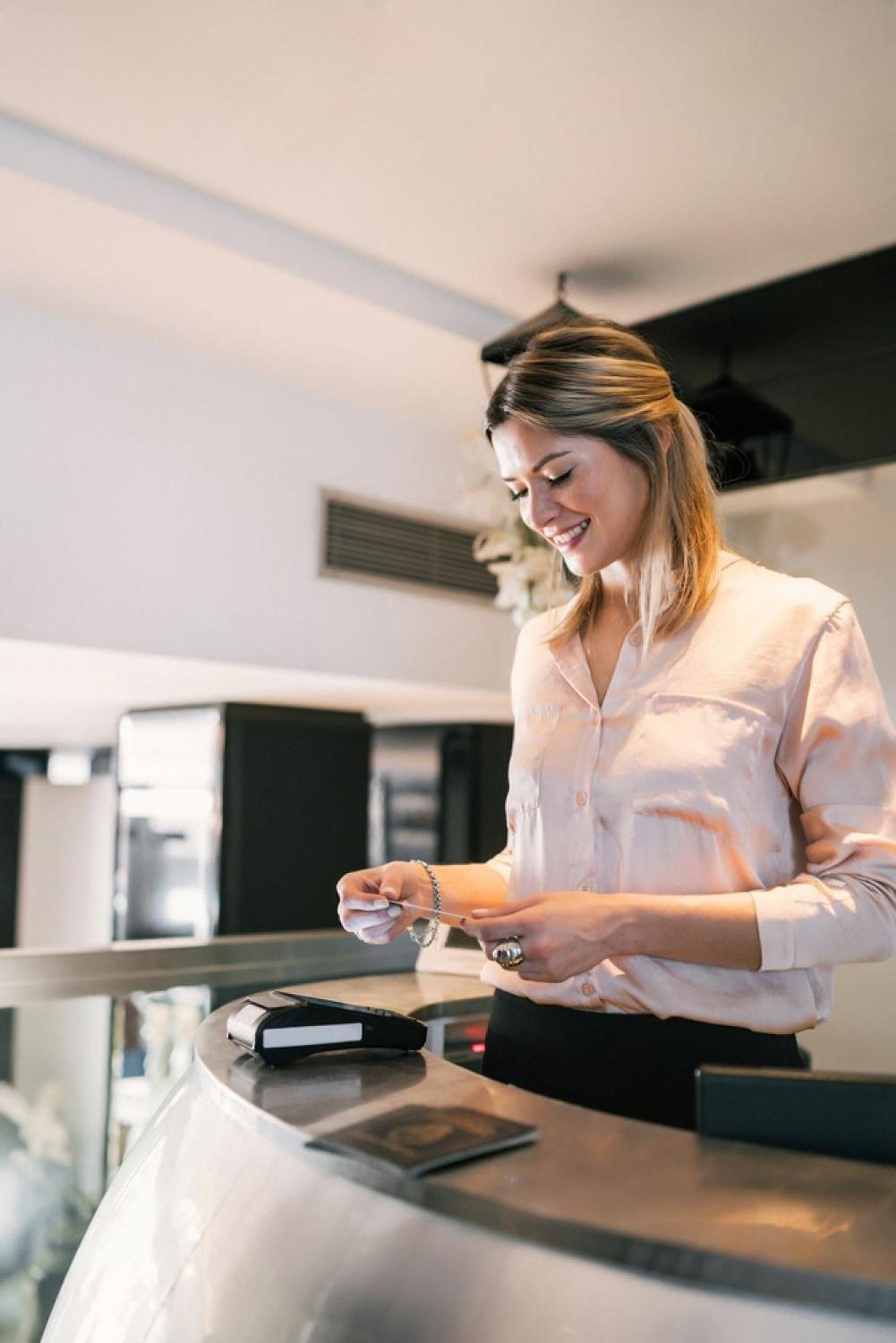
Trend 02
Passport and Emirates ID scanning is replacing manual entry
UAE regulation requires hotels to register every guest with the local authorities, which historically meant a receptionist typing passport details line by line. That is the single slowest part of the old process.
- OCR scanners read the full passport MRZ in under two seconds
- Emirates ID is captured contactlessly for resident guests
- Guest data flows straight into the PMS and the police reporting feed
- Fewer typos, which means fewer compliance headaches
The receptionist is still there, but they are supervising three or four parallel check-ins instead of grinding through one.
Trend 03
The smartphone is becoming the room key
Pre-arrival check-in
Guests complete registration from the airport taxi, confirm arrival time, and pick preferences before they ever reach the lobby.
Mobile room keys
Bluetooth and NFC unlock the door from a branded app, so a traveller can go straight from the car to their floor.
In-stay requests
Housekeeping, late checkout and dining bookings move onto the same channel, which cuts phone traffic to the front desk.
“The hotels that will win the next five years in this region are the ones that treat the lobby as a hospitality space, not a processing queue. Technology is what makes that possible.”
Trend 04
Staff are being redeployed, not replaced
The misconception about self-check-in is that it eliminates jobs. In practice, UAE operators are redirecting receptionist hours into guest-facing roles that generate loyalty and revenue: lobby hosts, concierge support, upsell specialists at kiosk zones. The transactional part of the job disappears; the hospitality part grows.
- Lobby ambassadors greet arrivals and walk first-time users through the kiosk.
- Upsell agents offer room upgrades, late checkout and spa bookings beside the kiosks, with much higher conversion than at the counter.
- Problem solvers handle the 10 to 15 percent of cases that genuinely need human judgement: group arrivals, long-stay guests, special requests.
- Night-shift staff shrink in number but gain tools, since the kiosk handles the simple 2am walk-in.
The headline numbers behind the shift
60 to 90 seconds
Typical self-check-in flow, from passport scan to keycard in hand, once the guest’s booking is matched.
Up to 70% fewer peak-hour queues
Reported by UAE operators that have deployed three or more kiosks alongside a traditional desk.
What guests actually feel
Less friction, more hospitality
For the guest, the difference is simple: the lobby stops feeling like an airport counter and starts feeling like an arrival. You scan your passport, confirm your room category, tap your card, collect your key, and head upstairs. If something is unusual, a staff member is standing right there, no clipboard, no partition.
That is the real reason the industry is moving. Not cost-cutting, not fashion, but because the alternative, a tired traveller stuck behind nine other tired travellers at 11pm, is a brand problem that compounds every single night.
Within three years, I expect self-check-in to be the standard first touchpoint in every UAE four and five star property, with a human host beside it rather than behind a desk.
What the next 24 months look like
The trajectory is clear enough that most hotel groups are already past the pilot stage. Three things to watch across the UAE market:
- Facial recognition at the kioskmatched against passport photos for returning guests, cutting the second visit to around 20 seconds.
- Integration with UAE Passso resident guests skip ID capture entirely.
- Deeper personalisationwith the kiosk recognising loyalty tier, preferred room location, and past dining choices before the guest finishes tapping.
The front desk is not disappearing. It is becoming something more useful, a place where a human talks to you because they want to, not because they have to type your passport number into a screen.
Frequently asked questions
Are self-check-in kiosks safe for storing passport and payment data?
Yes, when the kiosk is deployed by a reputable vendor and connected to the hotel’s property management system over an encrypted channel. Passport scans are passed into the PMS and the mandatory police reporting feed, not stored on the device itself. Payments go through the same PCI-compliant gateway the hotel already uses at the front desk.
Can guests still check in with a human at the reception if they prefer?
Almost every UAE hotel that has rolled out kiosks has kept the traditional desk open. The two run in parallel. Guests who want a conversation, have a complex booking, or are travelling with a group can still go straight to a receptionist. The kiosk is an option, not a replacement.
How long does a self-check-in actually take?
For a standard booking with a clean passport scan, most guests finish in 60 to 90 seconds. That includes selecting the booking, scanning ID, confirming payment authorisation and collecting the keycard. Repeat guests who use mobile check-in before arrival can be in their room within a minute of walking through the door.
Do self-check-in kiosks work for family bookings and multiple rooms?
Modern kiosks handle multi-room reservations and additional guests tied to a single booking. The lead guest scans their ID, confirms the other names on the reservation, and receives multiple keycards from the same session. Children under the registration age do not need to scan anything.
What happens if the kiosk cannot read a passport or the booking is not found?
The screen prompts the guest to call a lobby host, who is almost always within a few metres. The host can either rescan the document manually or complete the check-in at the desk. In practice, these fallback cases are rare, under 10 percent of attempts, and they get resolved in under two minutes.
Will self-check-in cost hotels fewer staff?
Not usually. What changes is the role mix. Hotels tend to keep roughly the same headcount on the front office payroll but move people out from behind the counter and into guest-facing hospitality: lobby ambassadors, upsell specialists, concierge support. The transactional work shrinks, the service work grows.

Cyclist, feminist, drummer, Saul Bass fan and front-end developer. Working at the sweet spot between beauty and mathematics to answer design problems with honest solutions. I sometimes make random things with friends.